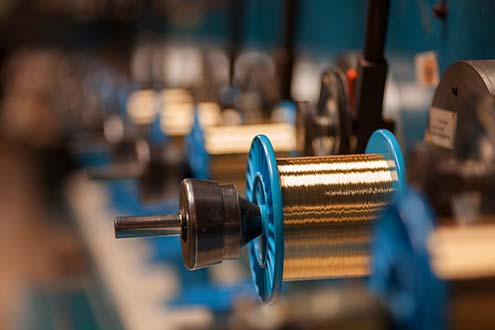
Brass Wire
Ken-tron draws brass wire across the full family of copper-zinc alloys covered by ASTM B134/B134M — including Brass 230, Brass 240, Brass 260, Brass 270, and others — for customers producing electrical components, electronic parts, mechanical fasteners, cold heading, brushes, springs, jewelry, connector springs, safety/locking wire, and cable assemblies. The most commonly ordered grade is CDA 24000 (Low Brass, UNS C24000), an 80% copper / 20% zinc composition prized for its balance of ductility, strength, and corrosion resistance.
Brass 230 (85/15) and Brass 240 (80/20) are copper-zinc alloys used as wrap wire for music strings, while Brass 260, 270, and 340 are commonly used for wood and cap screws, rivets, and other fasteners; when work-hardened, these alloys are also used in spring applications. Brass wire is supplied in round, hexagonal, octagonal, rectangular, and square cross-sections. It is non-magnetic, resists general atmospheric corrosion, and is readily cold-drawn and formed, making it a workhorse material for stamped and formed electrical and mechanical components.
Brass Alloy Family
| UNS No. | Trade Name | Copper % | Notes |
|---|---|---|---|
| C21000 | Gilding Metal, 95% | 94.0 – 96.0 | Highest ductility of the series; jewelry, ammunition components |
| C22000 | Commercial Bronze, 90% | 89.0 – 91.0 | Good color match to bronze; hardware, ornamental |
| C22600 | Jewelry Bronze, 87.5% | 86.0 – 89.0 | Ornamental and decorative wire forms |
| C23000 | Red Brass, 85% | 84.0 – 86.0 | Plumbing, electrical, weatherstripping |
| C23400 | — | 81.0 – 84.0 | Intermediate strength/ductility |
| C24000 (most common) | Low Brass, 80% | 78.5 – 81.5 | Electrical contacts, connector springs, safety wire |
| C26000 | Cartridge Brass, 70% | 68.5 – 71.5 | Deep-drawn parts, cartridge cases, springs |
| C27000 | Yellow Brass | 63.0 – 68.5 | General-purpose stamped hardware |
| C27400 | Yellow Brass | 61.0 – 64.0 | General-purpose stamped hardware |
Chemical Composition
| UNS No. | Copper % | Lead % max | Iron % max | Zinc % |
|---|---|---|---|---|
| C21000 | 94.0 – 96.0 | 0.05 | 0.05 | Remainder |
| C22000 | 89.0 – 91.0 | 0.05 | 0.05 | Remainder |
| C22600 | 86.0 – 89.0 | 0.05 | 0.05 | Remainder |
| C23000 | 84.0 – 86.0 | 0.05 | 0.05 | Remainder |
| C23400 | 81.0 – 84.0 | 0.05 | 0.05 | Remainder |
| C24000 | 78.5 – 81.5 | 0.05 | 0.05 | Remainder |
| C26000 | 68.5 – 71.5 | 0.07 | 0.05 | Remainder |
| C27000 | 63.0 – 68.5 | 0.09 | 0.07 | Remainder |
| C27400 | 61.0 – 64.0 | 0.09 | 0.05 | Remainder |
Source: ASTM B134/B134M-08, Table 1. When all elements for a given alloy are determined, their combined sum must be 99.8% min (C21000–C24000) or 99.7% min (C26000/C27000/C27400); zinc, listed as the remainder, is the difference between the sum of determined elements and 100%.
Mechanical Properties — CDA 24000 (Low Brass)
Tensile Strength by Temper, Round/Hex/Octagonal/Square Wire (grouped with C23400)
| Temper Code | Name | Tensile Strength (ksi) |
|---|---|---|
| H00 | Eighth-Hard | 50 – 65 |
| H01 | Quarter-Hard | 62 – 75 |
| H02 | Half-Hard | 78 – 90 |
| H03 | Three-Quarter-Hard | 90 – 101 |
| H04 | Hard | 100 – 110 |
| H06 | Extra-Hard | 112 – 121 |
| H08 | Spring | 116 min |
Source: ASTM B134/B134M-08, Table 3 (C23400 & C24000 column). H04 (hard) temper is not generally available over 1/2 in. diameter; H06 not generally available over 3/8 in.; H08 not generally available over 1/4 in.
Grain Size (Annealed Tempers)
For deep-drawing or spinning applications, C24000 is available in OS070, OS050, OS035, OS025, OS015, and OS010 annealed tempers per ASTM B601 grain-size classification. Approximate Rockwell F hardness for OS050 ranges 53–64; OS015 ranges 66–83 (per ASTM B134, Table 2).
Physical Properties
| Property | Value |
|---|---|
| Density (C24000) | ≈0.308 lb/in³ |
| Melting Point (C24000) | ≈1,725°F |
| Electrical Conductivity | ≈27% IACS (varies by alloy) |
| Magnetic Permeability | Non-magnetic |
Physical property values are typical reference figures for C24000; ASTM B134/B134M covers chemistry and mechanical requirements only and does not specify density, melting point, or conductivity. Confirm exact figures against a current mill data sheet before publishing.
Cold Forming & Drawing
Brass wire is readily cold drawn and work-hardens predictably through the H00–H10 temper range. Ken-tron draws brass to fine diameters for spring and contact applications, and can supply annealed, quarter-hard through extra-spring tempers, plus deep-drawing grain sizes for stamped and formed parts.
Applicable Standards & Specifications
| Standard | Scope | Grade |
|---|---|---|
| ASTM B134/B134M-08 | Round, hexagonal, octagonal, rectangular, and square brass wire | C21000 – C27400 |
| ASTM B250/B250M | General requirements for wrought copper alloy wire (dimensional tolerances, sampling) | All copper alloy wire |
| ASTM B601 | Temper designations for copper and copper alloys | All tempers referenced above |
Industries & Applications
| Industry | Typical Applications |
|---|---|
| Electrical & Electronics | Cable assemblies, connector springs, electrical contacts |
| Aerospace & Defense | Safety/locking wire, control cables |
| Hardware & Fasteners | Mechanical fasteners, ornamental wire forms |
| Weaving & Filtration | Woven wire cloth and mesh |
Brass (C24000) vs. Phosphor Bronze (C52100)
Both are common copper-based alloys, but phosphor bronze’s tin/phosphorus content gives it higher strength, better fatigue life, and better corrosion resistance in the tempers most often used for springs:
| Property | Brass C24000 | Phosphor Bronze C52100 (92/8) |
|---|---|---|
| Composition | 78.5–81.5% Cu, remainder Zn | Remainder Cu, 7.0–9.0% Sn, 0.03–0.35% P |
| Typical Tensile (Hard temper) | 100–110 ksi | 125–150 ksi |
| Corrosion Resistance | Good in atmospheric service | Better — resists fatigue and stress-relaxation in spring service |
| Typical Use | Contacts, safety wire, stamped hardware | Springs, music wire, relay/switch components |
Ken-tron Wire Drawing Capability
The Ken-tron Wire Division specializes in small-diameter, close-tolerance wire made to customer specifications. Our manufacturing process for brass wire includes:
- Incoming material verification — mill certifications reviewed, chemistry confirmed against applicable standard
- Controlled cold reduction — percentage reduction between anneals managed to achieve target temper and dimensional tolerance
- In-process and final annealing — continuous strand annealing to provide uniform softening and consistent grain size
- Dimensional inspection — diameter measured using calibrated gauges; tolerance held to customer specification
- Surface inspection — wire examined for seams, laps, or inclusions affecting fatigue performance or solderability
- Certification and documentation — mill certs and material traceability furnished with each shipment
Ken-tron manufactures to your custom specifications. For additional inquiries, please request a quote or contact us.