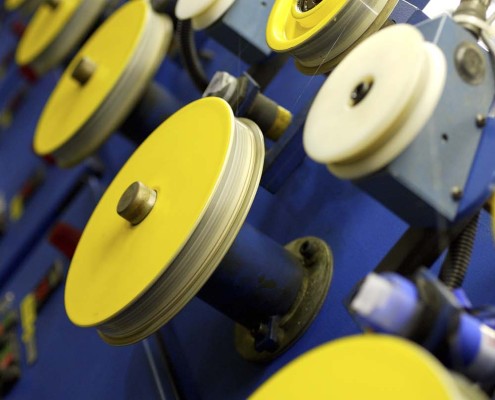
Haynes 25
Ken-tron draws Haynes® 25, Haynes® 214, Haynes® 230, Haynes® NS-163, Haynes® Waspalloy, and other high-temperature alloys for customers in the aerospace, power generation, medical, weaving, spring, and other industries. Haynes® 25 (also known as L-605, UNS R30605) is the most commonly ordered grade in this family — a cobalt-nickel-chromium-tungsten alloy prized for its combination of high-temperature strength and oxidation resistance.
Haynes® 25 is a 52% cobalt, 20% chromium, 10% nickel, 15% tungsten alloy (nominal composition 52Co-20Cr-10Ni-15W). It maintains useful strength up to 1,500°F (816°C) and oxidation resistance up to 2,000°F (1,093°C), making it a standard choice for hot-section aerospace hardware, high-temperature springs, and corrosion-resistant weaving applications.
Chemical Composition
| Element | Haynes® 25 / L-605 (wt%) |
|---|---|
| Carbon (C) | 0.05 – 0.15 |
| Manganese (Mn) | 1.00 – 2.00 |
| Silicon (Si) | 1.00 max |
| Phosphorus (P) | 0.04 max |
| Sulfur (S) | 0.03 max |
| Chromium (Cr) | 19.00 – 21.00 |
| Nickel (Ni) | 9.00 – 11.00 |
| Tungsten (W) | 14.00 – 16.00 |
| Iron (Fe) | 3.00 max |
| Cobalt (Co) | Remainder |
Source: SAE AMS5796F, Table 1. AMS5796 is written as a welding-wire specification (composition similar to UNS R30605); Ken-tron references its chemistry as the industry-standard definition of Haynes® 25 / L-605 and draws the alloy to general wire tempers and tolerances beyond the welding-wire scope of AMS5796 itself.
Mechanical Properties
Ken-tron Typical Drawn-Wire Tensile Strength
| Condition | Tensile Strength (ksi) |
|---|---|
| Annealed | 138 – 160 |
| Spring Temper (Hard) | 203 – 261 |
Source: Ken-tron typical values for cold-drawn wire. A separate general reference range sometimes quoted for hard-temper material is 200,000–270,000 psi, with soft/annealed material at 185,000 psi maximum; actual achievable range depends on diameter and cumulative cold reduction. Confirm target temper with Ken-tron engineering for a specific application.
Temperature Coefficient of Thermal Expansion
| Temperature Range | Mean CTE (µm/m/°C) |
|---|---|
| 25 – 100°C | 12.3 |
Physical Properties
| Property | Value |
|---|---|
| Density | 0.330 lb/in³ |
| Melting Point | ≈2,570°F |
| Magnetic Permeability | Essentially non-magnetic (austenitic cobalt matrix) |
High-Temperature Performance
- Retains useful strength for structural service up to 1,500°F (816°C)
- Resists scaling and oxidation in air up to 2,000°F (1,093°C)
- Cobalt-base austenitic matrix provides good ductility and formability in the annealed condition
- Widely used historically as gas-tungsten-arc and gas-metal-arc welding filler wire for joining alloys of similar or dissimilar high-temperature composition
Cold Forming & Drawing
Haynes® 25 work-hardens rapidly, similar to austenitic stainless steel, and requires controlled reduction schedules with intermediate vacuum or protective-atmosphere annealing to avoid surface oxidation and cracking during drawing. Ken-tron draws the alloy to fine diameters for spring and weaving applications where high-temperature strength must be retained in service.
Applicable Standards & Specifications
| Standard | Scope | Grade |
|---|---|---|
| SAE AMS5796F | Cobalt alloy, corrosion and heat-resistant welding wire — chemistry reference | Haynes® 25 / L-605, UNS R30605 |
| UNS R30605 | Unified Numbering System designation | Haynes® 25 / L-605 |
Industries & Applications
| Industry | Typical Applications |
|---|---|
| Aerospace | Jet-engine hot-section hardware, exhaust components |
| Power Generation | High-temperature springs, combustion hardware |
| Medical | Implantable devices requiring high strength and biocompatibility |
| Weaving & Filtration | High-temperature woven wire cloth and mesh |
Haynes® 25 vs. Incoloy 825
Both are high-performance, corrosion-resistant alloys, but they are optimized for different service environments:
| Property | Haynes® 25 (L-605) | Incoloy 825 |
|---|---|---|
| Base Metal | Cobalt (52% Co nominal) | Nickel-iron (38–46% Ni) |
| Primary Strength | High-temperature strength to 1,500°F | Corrosion resistance in acid/chemical service |
| Oxidation Resistance | To 2,000°F | Not intended for high-temperature oxidizing service |
| Typical Use | Aerospace hot sections, high-temp springs | Chemical processing, sulfuric/phosphoric acid service |
Ken-tron Wire Drawing Capability
The Ken-tron Wire Division specializes in small-diameter, close-tolerance wire made to customer specifications. Our manufacturing process for Haynes® 25 wire includes:
- Incoming material verification — mill certifications reviewed, chemistry confirmed against applicable standard
- Controlled cold reduction — reduction schedule managed to avoid cracking in this rapidly work-hardening alloy
- In-process and final annealing — vacuum or protective-atmosphere annealing to prevent surface oxidation
- Dimensional inspection — diameter measured using calibrated gauges; tolerance held to customer specification
- Surface inspection — wire examined for seams, laps, or inclusions affecting high-temperature fatigue life
- Certification and documentation — mill certs and material traceability furnished with each shipment
Ken-tron manufactures to your custom specifications. For additional inquiries, please request a quote or contact us.