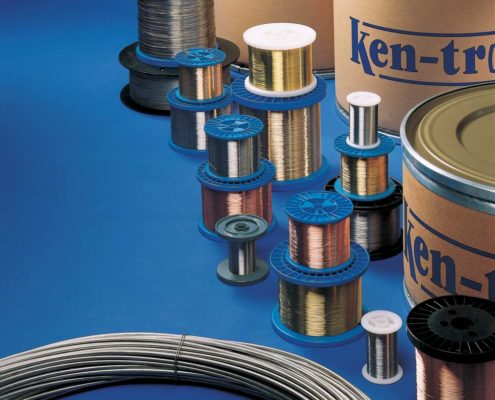
Kovar Wire
Ken-tron draws Kovar wire to a range of diameters for customers in the aerospace, automotive, defense, electronics, and telecommunications industries. Glass-to-metal seal and glass-to-ceramic seal applications are also common uses of this Ken-tron controlled-expansion wire. Kovar is the most commonly ordered grade in this alloy family, and was formerly supplied to ASTM F15. Ken-tron now draws Kovar to SAE AMS-I-23011, Class 1 (the current governing reference, which carries forward the F15 chemistry, temper, and thermal-expansion requirements).
Kovar is a 29% nickel, 17% cobalt, iron-balance alloy suitable for glass and ceramic sealing to metal, engineered to closely match the thermal expansion of hard, low-expansivity borosilicate glasses. Its combination of matched expansion, high strength, and high electrical resistance makes it the standard choice for hermetic glass-to-metal and ceramic-to-metal seals in semiconductor packages, vacuum tubes, and lead wire for mercury switches.
Chemical Composition
Kovar (AMS-I-23011, Class 1) — all values weight percent; maximum unless a range or nominal value is shown:
| Element | Kovar (wt%) |
|---|---|
| Nickel (Ni) | 29 (nominal) |
| Cobalt (Co) | 17 (nominal) |
| Chromium (Cr) | — (not specified for Class 1) |
| Manganese (Mn) | 0.50 max |
| Silicon (Si) | 0.20 max |
| Carbon (C) | 0.06 max |
| Aluminum (Al) | 0.10 max |
| Magnesium (Mg) | 0.10 max |
| Zirconium (Zr) | 0.10 max |
| Titanium (Ti) | 0.10 max |
| Iron (Fe) | Remainder |
Source: SAE AMS-I-23011C, Table II (Class 1) — the current governing reference for the alloy formerly supplied to ASTM F15. Total permissible content of aluminum, magnesium, zirconium, and titanium combined shall not exceed 0.20%. Nickel and cobalt are nominal contents, adjusted by the supplier as needed to meet the thermal-expansion requirement.
Mechanical Properties
Tensile Strength by Temper
| Temper | Tensile Strength (ksi) |
|---|---|
| Annealed | 85 max |
| 1/4 Hard | 90 – 115 |
| 1/2 Hard | 105 – 125 |
| Hard | 120 min |
Hardness, Rockwell B (Class 1)
| Condition | Hardness (Rockwell B) |
|---|---|
| Annealed | 85 max |
| 1/4 Hard | 90 – 93 |
| 1/2 Hard | 94 – 96 |
Source: SAE AMS-I-23011C, Tables IV & V.
Temperature Coefficient of Thermal Expansion
| Temperature Range | Mean CTE (cm/cm/°C × 10⁻⁶) |
|---|---|
| 30 – 400°C | 4.6 – 5.2 |
| 30 – 450°C | 5.1 – 5.5 |
Source: SAE AMS-I-23011C, Table III (Class 1). Kovar is formulated to match the expansion of hard, low-expansivity borosilicate glasses, which have setting-point temperatures of roughly 450–472°C and offer high thermal-shock resistance, high strength, and high electrical resistance.
Physical Properties
| Property | Value |
|---|---|
| Density | 0.302 lb/in³ |
| Melting Point | ≈2,640°F |
| Electrical Resistivity | 294 ohm-cir mil/ft |
| Magnetic Permeability | Ferromagnetic (unlike austenitic stainless or 52 Alloy in some tempers) |
Sealing to Glass and Ceramic
Kovar (Class 1) is one of seven classes of iron-nickel and iron-nickel-cobalt sealing alloys covered by SAE AMS-I-23011 (successor to MIL-I-23011). Each class is formulated to match a specific family of sealing glass or ceramic:
- Class 1 (Kovar, 29% Ni – 17% Co) — hard, low-expansivity borosilicate glasses requiring high thermal-shock resistance, high strength, and high electrical resistance.
- Class 2 (52 Alloy, 50.5% Ni) — soft, potash-soda-lead and soda-lime glasses; see Alloy Wire.
- Classes 3 & 6 — additional soft-glass sealing compositions.
- Class 4 (46% Ni) — most frequently used for sealing to glazed ceramics.
- Class 5 (41% Ni) — softer borosilicate and leaded glasses, including applications requiring high surface resistivity or radiation shielding.
Cold Forming & Drawing
Kovar work-hardens through the same temper range as other AMS-I-23011 sealing alloys and is readily cold drawn to fine diameters. Because the alloy’s expansion match to glass depends on maintaining tight compositional and dimensional control, Ken-tron verifies chemistry and grain structure at incoming inspection and holds close diameter tolerances through the drawing process to preserve hermetic-seal performance in the finished part.
Applicable Standards & Specifications
| Standard | Scope | Grade |
|---|---|---|
| SAE AMS-I-23011, Class 1 | Iron-nickel-cobalt sealing alloys — chemistry, temper, CTE, and dimensional tolerances | Kovar |
| ASTM F15 (historical / superseded) | Iron-nickel-cobalt sealing alloy, legacy designation | Equivalent to Class 1 |
Industries & Applications
| Industry | Typical Applications |
|---|---|
| Electronics & Semiconductor | Hermetic packages and headers, transistor and IC lead wire, glass-to-metal seals |
| Aerospace & Defense | Connector pins, hermetically sealed housings |
| Telecommunications | Sealed relay and switch components, lead wire for mercury switches |
| Automotive | Sensor housings requiring hermetic glass seals |
Kovar vs. 52 Alloy
Both alloys belong to the AMS-I-23011 sealing-alloy family but are matched to different glass types:
| Property | Kovar (Class 1) | 52 Alloy (Class 2) |
|---|---|---|
| Nominal Composition | 29% Ni, 17% Co, remainder Fe | 50.5% Ni, remainder Fe |
| Glass Type Matched | Hard, low-expansion borosilicate glass | Soft potash-soda-lead / soda-lime glass |
| CTE (30–450°C) | 5.1 – 5.5 × 10⁻⁶ cm/cm/°C | 9.6 – 10.1 × 10⁻⁶ cm/cm/°C |
| Typical Use | Semiconductor headers, vacuum-tube leads | Reed switches, mercury-switch lead wire |
Ken-tron Wire Drawing Capability
The Ken-tron Wire Division specializes in small-diameter, close-tolerance wire made to customer specifications. Our manufacturing process for Kovar wire includes:
- Incoming material verification — mill certifications reviewed, chemistry confirmed against applicable standard
- Controlled cold reduction — percentage reduction between anneals managed to achieve target temper and dimensional tolerance
- In-process and final annealing — continuous strand annealing to provide uniform softening, controlled atmosphere to minimize surface oxide
- Dimensional inspection — diameter measured using calibrated gauges; tolerance held to customer specification
- Surface inspection — wire examined for seams, laps, or inclusions affecting hermetic-seal performance
- Certification and documentation — mill certs and material traceability furnished with each shipment
Ken-tron manufactures to your custom specifications. For additional inquiries, please request a quote or contact us.
View our full color parts brochure (1.31 MB) in PDF format.