Phosphor Bronze Wire
Ken-tron draws Phosphor Bronze CDA 521, CDA 510, CDA 507, CDA 519, and other copper-tin alloys (UNS C51000, C52100, and C52400) for customers producing electrical contacts, electronic components, electrical switches, relays, mechanical fasteners, music wire strings, instruments, and woven products. The most commonly ordered grade is 92/8 Phosphor Bronze (C52100), an 8% tin composition prized for the combination of high strength, fatigue resistance, and corrosion resistance it brings to spring applications.
Phosphor bronze is a copper-tin alloy with a small, deliberate phosphorus addition (a residual deoxidizer from the casting process) that improves strength and spring performance. It offers high electrical conductivity relative to its strength, a comparatively low elastic modulus, and good corrosion resistance — qualities that make it a standard material for springs, contacts, and woven wire products.
Phosphor Bronze Grade Variants
| Grade | UNS No. | Tin Content | Typical Use |
|---|---|---|---|
| 95/5 Phosphor Bronze | C51000 | 4.2 – 5.8% | General wire forms; best formability of the three grades |
| 92/8 Phosphor Bronze (most common) | C52100 | 7.0 – 9.0% | Springs, music wire, relay/switch components |
| 90/10 Phosphor Bronze | C52400 | 9.0 – 11.0% | Highest strength; heavy-duty springs |
Chemical Composition
| Element | C51000 (wt%) | C52100 (wt%) | C52400 (wt%) |
|---|---|---|---|
| Copper (incl. silver) | Remainder | Remainder | Remainder |
| Lead, max | 0.05 | 0.05 | 0.05 |
| Iron, max | 0.10 | 0.10 | 0.10 |
| Tin | 4.2 – 5.8 | 7.0 – 9.0 | 9.0 – 11.0 |
| Zinc, max | 0.30 | 0.20 | 0.20 |
| Phosphorus | 0.03 – 0.35 | 0.03 – 0.35 | 0.03 – 0.35 |
Source: ASTM B159/B159M-17 (Reapproved 2024), Table 1. Copper, listed as the remainder, is the difference between the sum of determined elements and 100%; sum of all elements determined must be 99.5% min.
Mechanical Properties
Round or Square Wire, General Purpose
| Temper | C51000 (ksi) | C52100 (ksi) | C52400 (ksi) |
|---|---|---|---|
| O61 — Annealed | 48 – 63 | 53 – 68 | 60 – 75 |
| H01 — Quarter-Hard | 60 – 76 | 74 – 91 | 83 – 102 |
| H02 — Half-Hard | 80 – 97 | 95 – 115 | 108 – 129 |
| H03 — Three-Quarter-Hard | 96 – 115 | 113 – 135 | 125 – 148 |
| H04 — Hard | 108 – 128 | 125 – 150 | 135 – 160 |
Source: ASTM B159/B159M-17(2024), Table 2.
H08 Spring Temper — C51000 Round/Square Wire (by diameter)
| Diameter | Min. Tensile Strength (ksi) | Elongation, min % |
|---|---|---|
| 0.025 in. and under | 145 | — |
| Over 0.025 to 0.0625 in. | 135 | — |
| Over 0.0625 to 0.125 in. | 130 | — |
| Over 0.125 to 0.250 in. | 125 | — |
| Over 0.250 to 0.375 in. | 120 | 5.0 |
| Over 0.375 to 0.500 in. | 105 | 9.0 |
Source: ASTM B159/B159M-17(2024), Table 3.
Physical Properties
| Property | 92/8 (C52100) | 95/5 (C51000) |
|---|---|---|
| Density | 0.318 lb/in³ | 0.320 lb/in³ |
| Melting Point | ≈1,880°F | ≈1,940°F |
Bend / Formability Performance
Wire up to 0.250 in. in diameter produced from C51000 must withstand cold bending through 120° on a radius equal to the wire diameter without visible cracking; in H08 and H10 (spring) tempers, the bend must show no cracks or flaws visible to the unaided eye on the outside of the bend (per ASTM B159/B159M, Section 10.1). This bend performance underlies phosphor bronze’s reputation for reliable spring-back in relay and switch applications.
Applicable Standards & Specifications
| Standard | Scope | Grade |
|---|---|---|
| ASTM B159/B159M-17 (Reapproved 2024) | Round and flat phosphor bronze wire — chemistry, temper, mechanical, and bend requirements | C51000, C52100, C52400 |
| ASTM B139/B139M | Phosphor bronze rod, bar, and shapes | Same alloy family |
| ASTM B250/B250M | General requirements for wrought copper alloy wire | All copper alloy wire |
Industries & Applications
| Industry | Typical Applications |
|---|---|
| Music & Instruments | Music wire strings, wound instrument strings |
| Electrical & Electronics | Electrical contacts, switches, relays |
| Weaving & Filtration | Woven wire cloth and mesh |
| Fasteners & Springs | Mechanical fasteners, precision springs |
Phosphor Bronze (92/8) vs. Brass (C24000)
| Property | Phosphor Bronze C52100 (92/8) | Brass C24000 |
|---|---|---|
| Composition | Remainder Cu, 7.0–9.0% Sn, 0.03–0.35% P | 78.5–81.5% Cu, remainder Zn |
| Typical Tensile (Hard temper) | 125–150 ksi | 100–110 ksi |
| Corrosion / Fatigue Resistance | Better — preferred for spring service | Good in atmospheric service |
| Typical Use | Springs, music wire, relay/switch components | Contacts, safety wire, stamped hardware |
Ken-tron Wire Drawing Capability
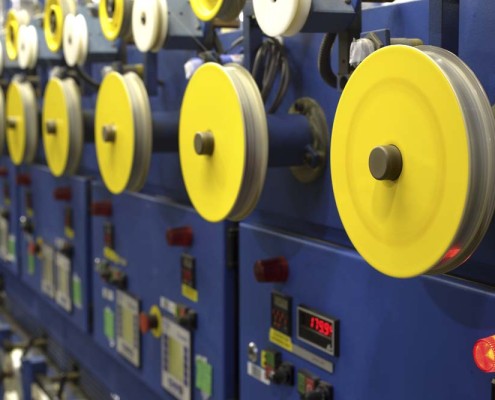
The Ken-tron Wire Division specializes in small-diameter, close-tolerance wire made to customer specifications. Our manufacturing process for phosphor bronze wire includes:
- Incoming material verification — mill certifications reviewed, chemistry confirmed against applicable standard
- Controlled cold reduction — percentage reduction between anneals managed to achieve target temper and spring performance
- In-process and final annealing — continuous strand annealing to provide uniform softening and consistent grain size
- Dimensional inspection — diameter measured using calibrated gauges; tolerance held to customer specification
- Surface inspection — wire examined for seams, laps, or inclusions affecting fatigue performance
- Certification and documentation — mill certs and material traceability furnished with each shipment
Ken-tron manufactures to your custom specifications. For additional inquiries, please request a quote or contact us.